Rainbow Bee Eater Nesting Behaviour
The Rainbow Bee Eater is just one of those birds that has always caught my eye. With their beautiful plumage and insatiable hunger for insects, I just can’t get enough.
Over the years they had slowly become a sort of mythical bird for me. They were birds that I was positive that they actually existed, but my only real experience with them was longingly staring at their images in the many Australian bird field guide books that I owned.
There were a lot times where I was out in the field photographing something completely different and minding my own business, when I would get a quick Bee Eater glimpse here, or a frog croak like call there. They were around, but apparently I just wasn’t ready to let the Rainbow Bee Eater into my life and/or heart just yet.
After a few years of trying to understand their behaviour and tracking down their favourite locations, I finally got a shot - the standard “bird on a fence” image.
Bird on a Fence | Panasonic S5 + Sigma 150-600
Don’t get me wrong, this is a nice image. It shows off their colours beautifully, but it’s still in the same general flavour as the dreaded “bird on a stick” image. How riveting. I could do better.
sand dunes, grass, open spaces - This Is Bee Eater Country | Taken near the Lancelin Sand Dunes, Western Australia
It wasn’t until a trip to Western Australia to photograph the 2023 solar eclipse that I would have an opportunity to see and photograph more Rainbow Bee Eaters.
Western Australia generally has a lot of sandy soil across it’s vast expanses, making it perfect country for the Bee Eater. These are birds, after all, that build their nests (or tunnels) in sand.
While staying at a spot called the Wooramell River Retreat - a cattle station perched right next to a river - I could see and hear lots and lots of bird life in the area. This was good news!
And so, this was where I had the opportunity to make my dreams come true and just bask in everything Rainbow Bee Eater. From bird on a stick shots, to bird in flight shots, and insect eating shots - I had access to a lot of different types of behaviours that I hadn’t seen before. After that moment I was hooked, and they soon became one of my (even more) favourite birds.
Whenever I look back on that epic trip, one where I witnessed a solar eclipse, I still fondly remember my time with the Rainbow Bee Eaters at this cattle station out in the middle of nowhere.
Rainbow Bee Eater In Flight | Nikon Z9 + Nikon 200-500
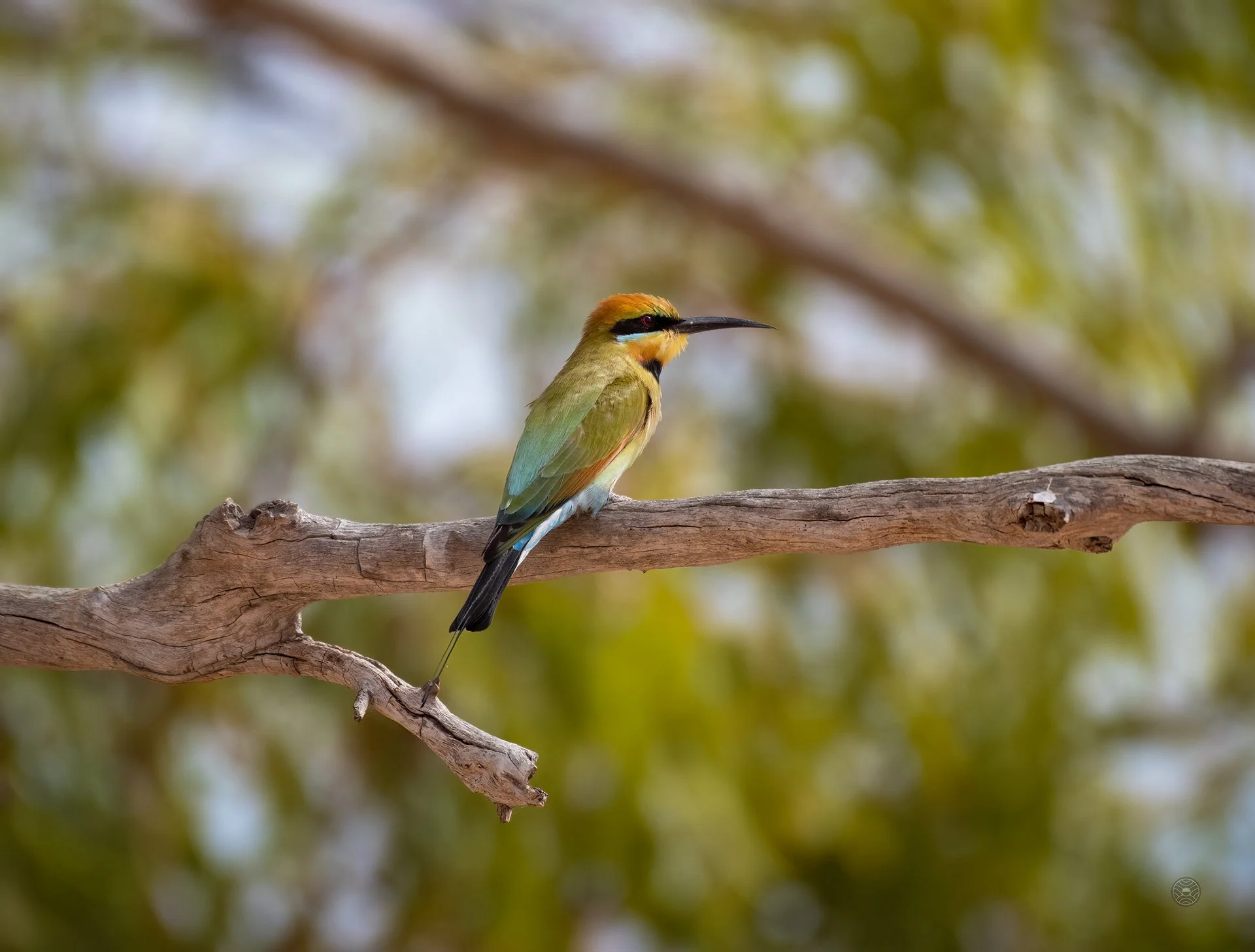
Bird On A Stick (But What A Bird!)
Nikon Z9 + Nikon 200-500
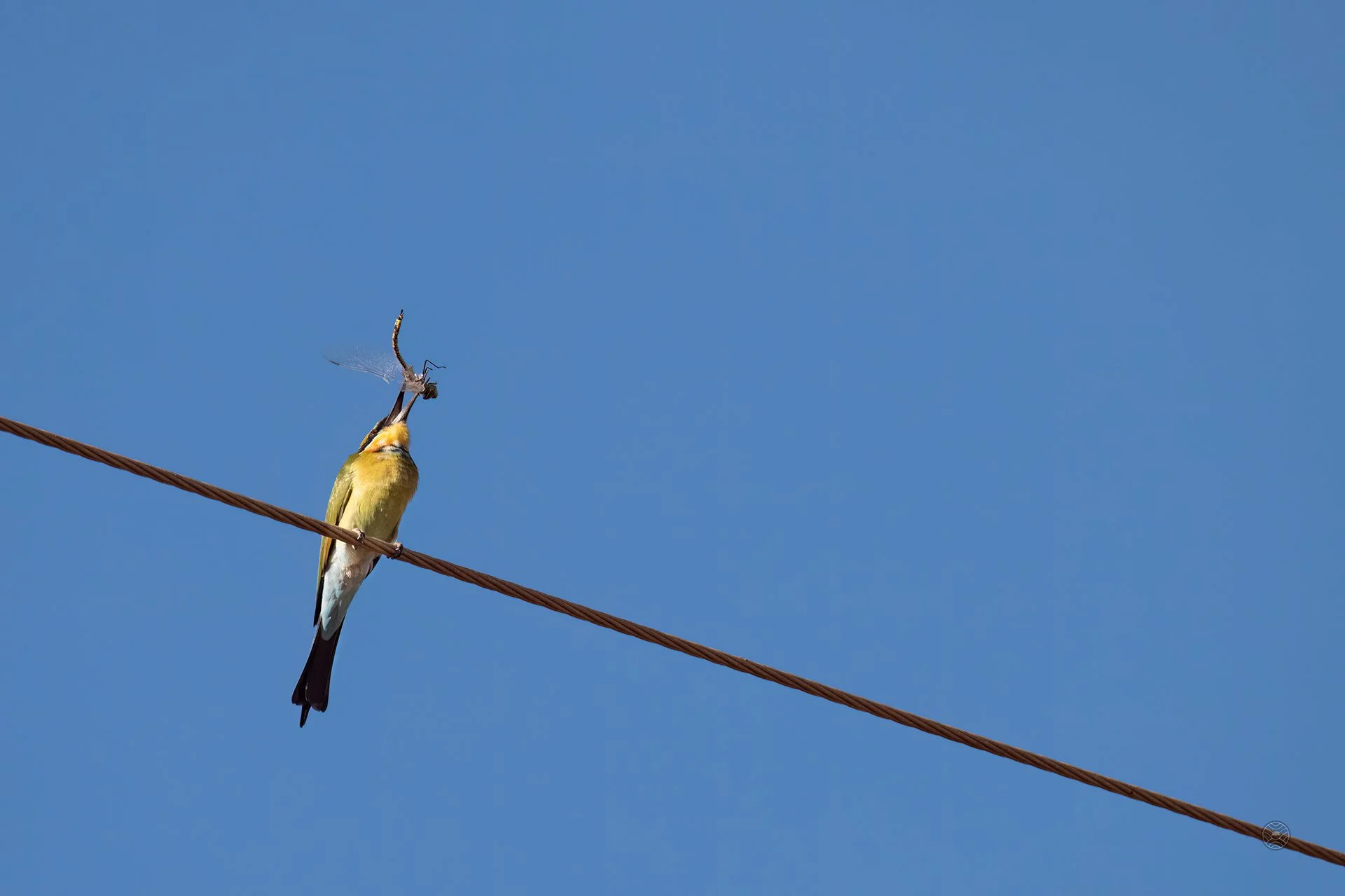
Dinner time!
But I wanted more. I wanted to see even more behaviour. I read that Bee Eaters of all types build their nests in tunnels, mostly in sandy soil. Sometimes there could be in colonies of up to 50 of these birds, all in their own little tunnel either on a dry river bank wall or even on the ground. This, I had to see.
In late 2025 I stayed at Amity Point on North Stradbroke Island. Now this is a place just brimming with wildlife - kangaroos, koalas, big fish and birds of all types - it has it all really.
But the moment I arrived my ears perked up to the call I am always on the lookout (or ear out) for. Searching the camp site, and following their sounds like some off brand Peppy Le Pew, I eventually saw a pair of Rainbow Bee Eaters hanging out on an old tree right on the beach. What made this different was that where one would stay on a branch of the tree, the other would fly off and scout around the freshly eroded sandy embankment on the beach, right next to camp site.
This was it, I thought. This would be the place where I would see nest/tunnel building action. I was weak at the knees at the thought of capturing this, so I rushed back to the cabin to get my gear.. as well as you can with weak knees..
Shift change | Nikon Z8 + Nikon 100-400
Now there’s not a lot to do on Stradbroke Island, especially if you don’t fish, 4WD or surf, so I spent probably 90% of my time down on the beach eating soft cheese while filming and photographing these birds.
Nikon Z5ii In Action
I utilised 2 cameras here - the main camera was the Nikon Z8 with a Nikon 100-400 f/4-5.6 lens and 1.4 teleconverter and the other, which I often used near the nest entrance, was a Nikon Z5ii with a Nikon 20mm lens.
Tunnel Scouting | Nikon Z8 + Nikon 100-400
It was such fascinating behaviour to watch. One would stay on the branch, and act as look out, while the other would fly (or glide) to the sandy embankment and start tunnelling away. After exactly 5 minutes the digger would return to the tree, and then the lookout would now take they’re turn digging in the tunnel. After 5 minutes they returned, and then the lookout would take their place. This happened all day, day after day.
Delicious | Nikon Z8 + Nikon 100-400
Of course while on lookout the munchies do get to you after awhile, so the urge to chase and gobble down a nearby insect was just too much.
Sunset Resting | Nikon Z8 + Nikon 100-400
My favourite shots from this entire encounter was on the last day of my time at Straddie. After 5 days of watching these birds I could now predict their behaviour - from when they began work in the morning, to when they called it quits at the end of the day.
After all their work was done they would always settle down to have one last feed and watch to the sunset.
This is my favourite shot from this encounter
The Rainbow Bee Eater folks | Nikon Z8 + Nikon 100-400
My time with these birds, in a typically beautiful Australian location like this no less, really enhanced my love and respect for them. The fact they build and nest in tunnels, the lookout/digger shift change, the aerobatic insect chasing, in fact all of their behaviour! - still really amazes me and fills me with so much awe.
There’s just somethin’ about ‘em, ladies and germs.
Please watch the above video of my time with these birds on North Stradboke Island.